The most effective way to reduce construction waste is to stop it before it exists: estimate accurately, order what the job needs, store materials properly and sort what is left on site. In British Columbia, municipal bylaws now add a second reason. Demolition and some construction permits come with diversion targets, deposits and compliance reports, so waste planning is part of running a compliant business. If you want to strengthen the estimating, procurement and scheduling skills behind this, our online self-paced video courses are approved by BC Housing for CPD credits, and they are priced at $29 per course.
TL;DR
- Waste is mostly decided before the crew arrives: take-offs, framing layouts, ordering and storage drive how much ends up in the bin.
- Sort on site into the main streams (wood, metal, cardboard, plastics, drywall) and keep them clean and dry. Source-separated loads typically cost less to dispose of than mixed loads.
- Municipal rules differ. Burnaby, Richmond, Vancouver and Squamish each set their own diversion targets, plans or deposits, so check your permit conditions before the job starts.
- Keep receipts, tonnage records and facility names. They support deposit refunds and show where your waste money goes.
- Estimating, procurement, scheduling and risk management are the business skills that keep waste down, and they are CPD topics you can study at your own pace.
Table of Contents
- Why waste reduction is now a business issue in BC
- Prevent waste before the job starts
- Sorting waste on site
- Reuse, recycling and what is realistic
- Waste rules and deposits in BC municipalities
- Track your waste like any other cost
- What waste reduction saves
- The skills behind low-waste building
- Perspective: why we link waste to business skills
- Take the next step with your CPD
- FAQ
- Sources
Why waste reduction is now a business issue in BC
Construction, renovation and demolition waste is a large share of what goes to landfill. A Metro Vancouver-region report prepared for BC Housing states that the construction and demolition industry produces more than 30% of total waste to landfill in Metro Vancouver. The Globe and Mail reports that up to one-third of landfill waste is connected to the construction industry, and that recycling construction materials instead of landfilling them saves money as material costs and tipping fees rise.
For a residential builder, that translates into three practical pressures:
- Cost. Every sheet of drywall, length of lumber or pallet of cladding you buy and throw away is paid for twice: once at the supplier and once at the disposal facility.
- Permits and deposits. Several BC municipalities require a waste diversion plan and hold a deposit until you prove you met the target.
- Client expectations. Homeowners and developers increasingly ask for low-carbon, low-waste builds.
Nationally, one older industry study reported that Canada’s construction, renovation and demolition sector generates about 11 million tonnes of solid waste a year, with a national diversion rate of 22% at the time. BC municipalities are now setting targets far above that.
Prevent waste before the job starts
Sorting and recycling matter, but prevention is cheaper. A waste guide published by the City of Saskatoon in 2025 is aimed at homebuilders and sets out a practical prevention checklist. Saskatoon is in Saskatchewan, so its bylaws do not apply in BC, but the site practices translate directly to any residential project. Its Homebuilder Waste Guide recommends:
- detailed framing layouts so material is used efficiently, backed by accurate take-offs;
- cutting the waste allowance built into estimates from the traditional 10% down to 0 to 5%;
- ordering materials as needed rather than stockpiling;
- choosing suppliers that give credit for unused materials;
- keeping accurate inventory records to avoid over-ordering;
- buying direct and in bulk to cut packaging, which the guide says is about 10% of construction waste;
- protecting stored materials from the weather.
Each of these is a business process, not a recycling task. That is where waste reduction connects to the CPD topics BC builders already study.
Estimating and take-offs
An accurate quantity take-off is the first waste-reduction tool. If your estimate pads every line by 10%, that padding arrives on site as extra material and usually leaves as debris. A tighter allowance only works when the framing layout, cut lists and drawings are good enough to support it. The work is to review the plans before ordering, compare the take-off against the layout and agree on the allowance line by line, rather than applying one blanket percentage.
Purchasing and delivery
Order in stages that match the schedule. Early bulk deliveries sit exposed, get damaged and become waste before they are installed. Before you place an order, ask the supplier whether unused, undamaged material can be returned for credit and what condition it must be in. Direct purchasing and bulk packaging reduce cardboard and plastic wrap at the source.
Storage and handling
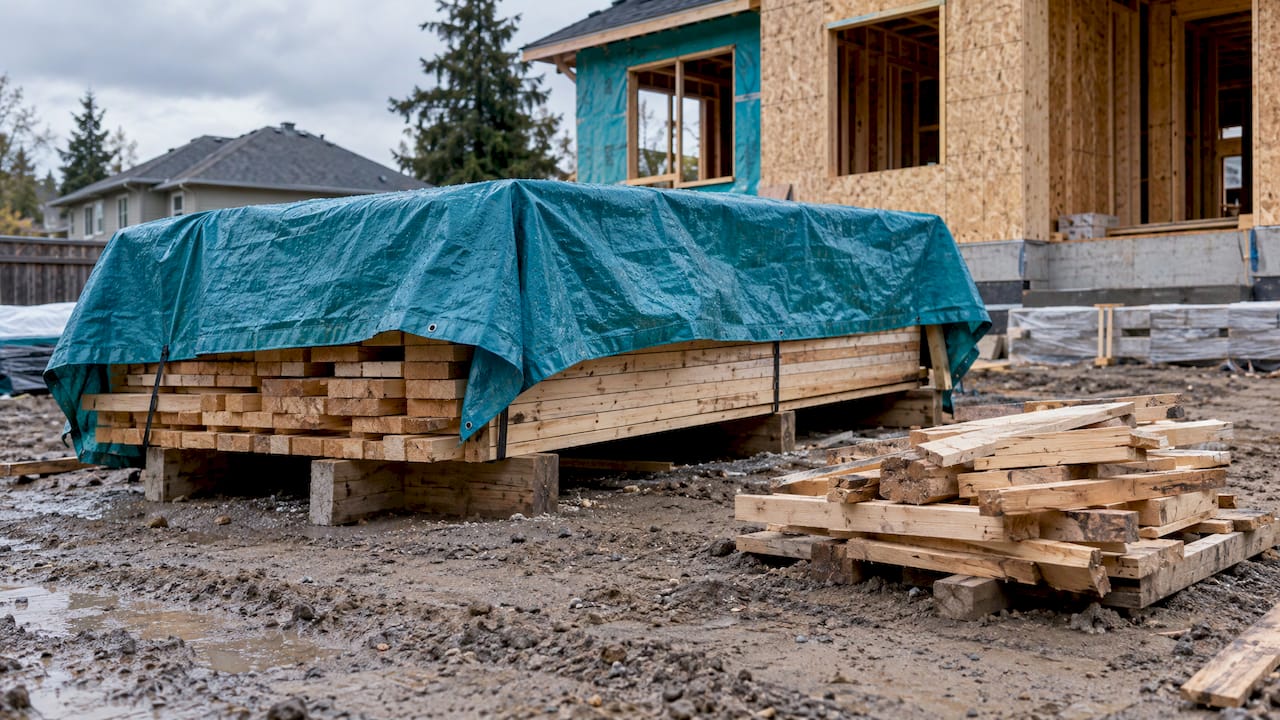
Materials that get wet, crushed or contaminated cannot be used or recycled easily. Raise stock off the ground, cover it, and designate a single laydown area so offcuts are collected in one place. Saskatoon’s guide also suggests a dedicated reuse area for items such as lumber, forming materials, shingles, bricks and cardboard, so crews can pull from offcuts before opening new stock.
Scheduling
A tight schedule reduces handling damage and rework. When trades overlap or deliveries arrive before a space is ready, material gets moved, scuffed and replaced. Sequencing deliveries with the build is a scheduling skill, and it pays off in the waste bin.
Sorting waste on site
Once waste is generated, how you separate it decides what you pay. Metro Vancouver’s Construction and Demolition Waste Reduction and Recycling Toolkit describes two approaches:
| Approach | How it works | Typical cost effect |
|---|---|---|
| Source-separated | Recyclables go into separate bins or compartments on site and are taken to a recycling facility | Typically lower tipping fees |
| Commingled | Recyclables go into one bin and are sorted at a facility | Typically higher fees |
For space-constrained urban lots, the toolkit notes that smaller bins with more frequent collection can work better than one large container.
The District of Squamish’s 2025 Construction and Demolition Waste Diversion Toolkit advises focusing on the main streams, which are wood, metal, cardboard and plastics, and keeping recyclable material clean and dry. Contaminated or wet loads are harder to place and can be downgraded to garbage.
A simple site sorting routine
- Before mobilization, decide which streams you will separate and where bins will sit.
- Label every bin with the accepted materials, using plain words and pictures that crews can read at a glance.
- Brief each trade at the start of its scope, not just at the site orientation.
- Check bins weekly for contamination and fix the cause (usually a bin placed too far from the work).
- Schedule pickups to match the build phases: framing generates lumber offcuts and packaging, finishing generates drywall and flooring waste.
The Squamish toolkit also notes that donating usable materials to the local not-for-profit Squamish Rebuild counts for double credits toward return of the demolition diversion deposit. Local reuse outlets exist in many BC communities, so ask your municipality what counts toward your target.
Reuse, recycling and what is realistic
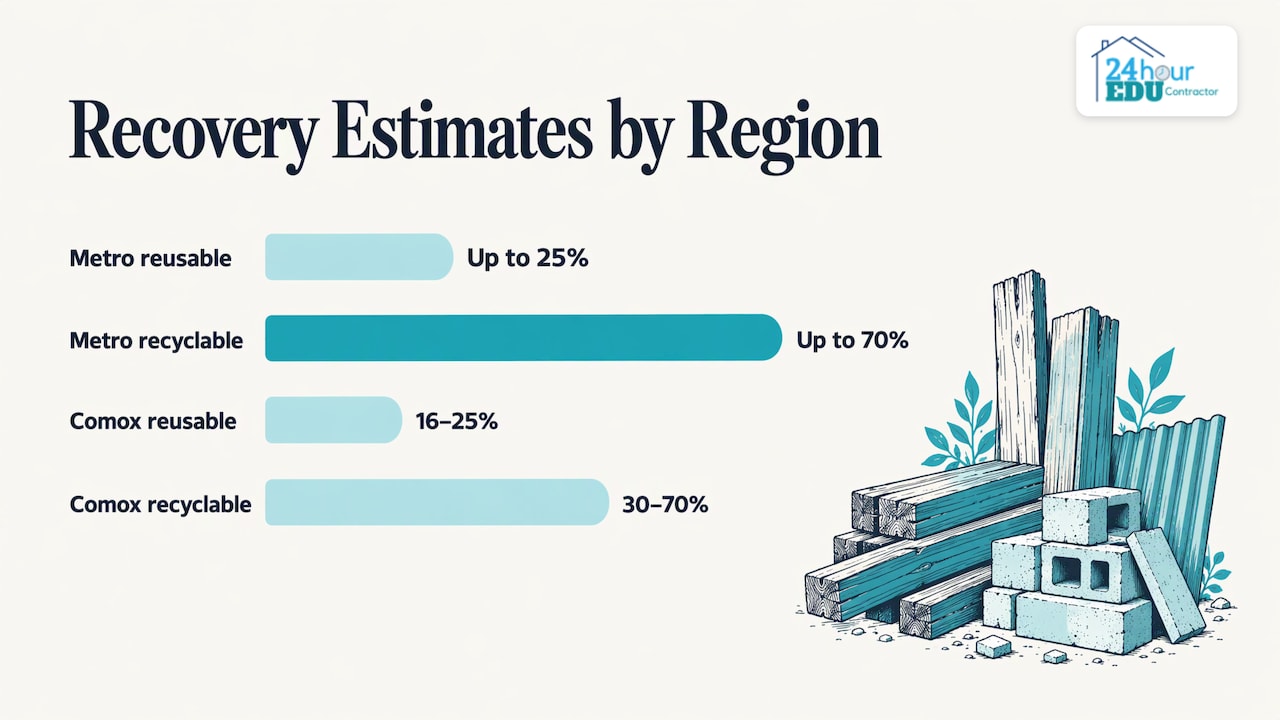
The Metro Vancouver toolkit states that in a typical home deconstruction, up to 25% of materials can be reused and up to 70% recycled. A 2026 regional market assessment for the Comox Valley Regional District reports a similar range for residential deconstruction: 16 to 25% reusable and 30 to 70% recyclable. The same assessment notes that salvaged lumber and steel often cannot go back into new structural applications because they lack engineering certification. Plan reuse accordingly: non-structural uses, such as framing for temporary works, blocking, fixtures, cabinets, doors and cladding, are easier to place.
BC Housing’s Vienna House report adds a design perspective. It argues that conventional recycling often downcycles material, and that the longer-term answer is Design for Disassembly, which aims to simplify deconstruction, reduce its time and cost, and allow maximum recovery of components. For a builder, that means thinking about mechanical fasteners, accessible connections and documented assemblies on new builds.
Waste rules and deposits in BC municipalities
In BC, diversion requirements are mostly set by municipalities and regional districts, so the first step on any job is to read the permit conditions for that location. Examples from official sources:
| Municipality | What applies |
|---|---|
| Burnaby | Bylaw adopted in June 2022 requires a Waste Diversion Plan, a deposit and a post-demolition Compliance Report. A full refund requires at least 70% diversion. The city reports a 91% average across 181 demolitions in 2025 and plans amendments to raise its target. |
| Vancouver | Demolition of 1- or 2-family homes built before 1950 requires at least 75% of materials by weight to be reused or recycled, and 90% for character homes. Homes built before 1910, and Heritage Register homes built before 1950, require deconstruction and at least 3 tonnes of wood saved for intact reuse. |
| Richmond | Its Demolition Waste and Recyclable Materials Bylaw has an 80% target. In October 2025 a council committee approved preparing amendments, and staff said the target will phase up to 90% as the market is ready. |
| Squamish | Its Solid Waste Utility Bylaw requires commercial and institutional properties to separate garbage, organics and recyclables, and limits mixed waste to 5% of the total. |
| Regional District of Nanaimo | Its Solid Waste Disposal Bylaw No. 1784 lists recyclables not accepted for landfilling, including gypsum, metal, wood waste and corrugated cardboard, with fines of $200 to $2,000 per day for contraventions. |
Metro Vancouver’s toolkit also notes that some of its municipalities require a waste management plan with the deconstruction or demolition permit application, plus a compliance report when the work is complete. These rules change, so confirm the current bylaw and target with the municipality before you price the job.
Hazardous materials
Some waste cannot be sorted into a recycling bin at all. Metro Vancouver’s toolkit states that construction and demolition waste, especially hazardous material, must never be dumped on the street, on the ground or into the sewer system. A qualified person must complete a hazardous materials survey before demolition, and hazardous waste must be managed and disposed of in compliance with the Hazardous Waste Regulation and the BC Environmental Management Act. Build the survey into your schedule and budget before demolition starts.
Track your waste like any other cost
Metro Vancouver’s toolkit advises monitoring waste management against your plan and asking contractors and haulers for records: the material type and quantity, the names and locations of facilities, and copies of recycling and disposal receipts and material-sale credits. Those records do two jobs:
- they prove diversion when a municipality asks for a compliance report or when you claim a deposit back;
- they show which streams cost you the most, so you can fix the cause upstream.
A simple job-level log works: date, bin type, material, weight or volume, facility, receipt number, cost. Reviewing it at the end of each phase tells you whether the waste allowance in your estimate was realistic. Good records also help when you report professional development and run your business files; our guide on professional recordkeeping best practices for BC residential builders covers the wider habit.
What waste reduction saves
The Globe and Mail reported that Nexus Modular’s indoor building approach cut the waste from a 2,000-square-foot home from 17,460 kg to 2,080 kg, and its greenhouse gas emissions from 7.80 tonnes to about 0.59 tonne. Most BC builders work on site rather than in a factory, but the figure shows how much waste is a result of process rather than necessity. The same article reports that the Building Material Exchange, launched in November 2024 with more than 150 BC development industry leaders, is an online business-to-business marketplace for listing and exchanging excess or salvaged construction materials. Surplus stock from one job can be another builder’s saving.
A CIB study of seven assessed sites found that recycling and reuse saved 1,073,563 kg of CO2e, with concrete reuse accounting for 69% of those savings. For a residential builder, the lesson is that high-weight materials such as concrete, masonry and lumber matter most when you decide where to focus.
The skills behind low-waste building
Look back at the prevention list: accurate take-offs, ordering to schedule, supplier terms, inventory records, storage, sequencing. None of these is a recycling skill. They are estimating, procurement, scheduling and risk management skills, which is why waste reduction fits into the professional development a BC residential builder already needs.
If you are planning your CPD, these topics from our catalogue connect directly to the practices above:
- Estimating, Bidding, & Procurement for Residential Contractors, for take-offs, bids and purchasing.
- Construction Scheduling and Timeline Management, for sequencing work and deliveries.
- Risk Management and Contingency Planning, for planning around delays, damage and change.
- Residential Building Science for Contractors, for how assemblies perform and how materials are protected.
If you are unsure how your hours are counted or reported, see our guides on BC residential builder licensing requirements and how to report your CPD to BC Housing.
Perspective: why we link waste to business skills
We hear the phrase waste reduction and think of the bin at the curb. The municipal rules in BC are real, and builders should know them. But the waste that costs the most is decided at the desk: the take-off that was rounded up, the order placed three weeks early, the delivery that arrived before the space was ready.
That is why our courses focus on the business side of residential building. Estimating, procurement, scheduling and risk management are the places where a builder controls what gets bought, when it arrives and how it is protected. Our courses are online self-paced video courses with no final exams, so you can work through them around your job schedule, and they are approved by BC Housing for CPD credits. Support is available seven days a week if you have questions along the way.
Treat waste as a cost you manage, with records and a plan, and the compliance side becomes easier too.
Chuck Pulaski
Take the next step with your CPD
Our courses are approved by BC Housing for CPD credits. They are online self-paced video courses with lifetime access, live customer support seven days a week and no final exams. Each course is a one-off $29, and you can see the full list of ten courses on our online courses for contractors page. If you are comparing options for your renewal, our page on construction continuing education for BC residential builders explains how the pieces fit.
For a broader view of what your business should cover each licensing cycle, see our guide to construction business compliance in BC.
FAQ
What is the fastest way to reduce construction waste on a residential job?
Start with the order. Check the take-off against the framing layout, trim the waste allowance where the drawings support it, and order in stages that match the schedule. Then separate wood, metal, cardboard and plastics into their own bins so the loads cost less to dispose of.
What types of construction waste can be recycled in BC?
The main streams are wood, metal, cardboard and plastics, and local bylaws can add others. The Regional District of Nanaimo, for example, does not accept gypsum, metal, wood waste or corrugated cardboard for landfilling. Keep materials clean and dry, and check with your regional district or municipality for the accepted list.
Do BC builders have to submit a waste plan?
It depends on the municipality and the permit. Burnaby requires a Waste Diversion Plan, a deposit and a compliance report for demolitions, and some Metro Vancouver municipalities require a waste management plan with deconstruction or demolition permits. Read your permit conditions before you start work.
How should hazardous waste be handled?
Never dump it on the street, the ground or into the sewer. A qualified person must complete a hazardous materials survey before demolition, and hazardous waste must be managed and disposed of under the Hazardous Waste Regulation and the BC Environmental Management Act.
Can I use salvaged lumber in new structures?
Often not for structural uses. A 2026 regional assessment notes that salvaged lumber and steel frequently lack the engineering certification needed for new structural applications. Non-structural uses are easier to place, and your engineer and building official can confirm what is acceptable on your project.
Sources
- City of Saskatoon Homebuilder Waste Guide (2025)
- Metro Vancouver Construction and Demolition Waste Reduction and Recycling Toolkit
- District of Squamish Construction and Demolition Waste Diversion Toolkit 2025
- BC Housing Vienna House: Design for Disassembly of Residential Construction
- CVRD Regional Market Assessment, Construction, Renovation and Demolition Waste (2026)
- City of Burnaby Solid Waste and Recycling Annual Report
- City of Vancouver: Reducing construction and demolition waste
- City of Richmond General Purposes Committee minutes, October 20, 2025
- Regional District of Nanaimo Solid Waste Disposal Bylaw No. 1784
- The Globe and Mail: B.C. building waste article, December 30, 2024
- CIB Waste reduction final report