If you hold a residential builder licence in British Columbia, the online education that matters most is the kind that earns CPD (Continuing Professional Development) points toward your renewal. Our courses are approved by BC Housing for CPD credits. They are online self-paced video courses, so you can work through them around your job sites, with no final exams. Each course costs $29 CAD, and access is for life.
This guide explains what BC Housing requires, what topics online courses cover, how to pick a course, and how to keep your records in order.
TL;DR
- BC Housing requires 20 CPD points in each one-year licence term, reported before your licence expiry date.
- Online courses are accepted, and course topics must connect to residential construction competencies such as building science, contracts, finance and business planning.
- Our courses are approved by BC Housing for CPD credits, are online self-paced video courses, and cost $29 CAD each, one-off.
- Keep proof of every activity for three years and complete each course in full, because audits can reduce points.
- Live customer support is available seven days a week if you need help along the way.
Table of Contents
- What “home builder education online” means for a BC licence holder
- What BC Housing requires: the 20-point rule
- What online courses cover
- How online courses differ in format
- How to choose a course that counts
- A practical routine for the licence term
- Our courses for BC residential builders
- Our view: CPD should fit the way builders work
- FAQ
- Sources
What “home builder education online” means for a BC licence holder
Search results for this topic mix several different things: diploma programs, certification pathways for people entering the trade, and short professional development courses. They answer different needs.
For a builder who already holds a licence, the need is specific. You must complete continuing education every licence term and report it to BC Housing, the provincial body that licenses residential builders. This is CPD. It is separate from the qualifications training that new applicants complete to get a licence in the first place. That entry training is built around seven core competency areas: relevant enactments, construction management and supervision, construction technology, customer service and home warranty insurance, financial planning and budget management, legal issues, and business planning, management and administration. BC Housing confirms that providers may offer qualifications courses online or by distance.
This article is for the licensed builder, general contractor or company owner who needs CPD points and wants to earn them online. If you are still working toward a first licence, start with the licensing requirements for BC residential builders.
What BC Housing requires: the 20-point rule
The rules come from the Homeowner Protection Act and its regulation, and BC Housing publishes them in plain terms.
- Amount: a minimum of 20 CPD points during each one-year licence term.
- Formal learning: 2 points per hour. This is structured training with a graded exam or assignment from a recognized provider.
- Informal learning: 1 point per hour.
- Carry-over: up to 20 extra points can carry over to the next term if the CPD nominee stays the same. The nominee is the person who completes the CPD on behalf of the licence.
- Records: keep proof of each activity for at least three years.
- Reporting: enter your points through the Licensed Residential Builders portal before you apply to renew.
All of this is on BC Housing’s CPD page. The Homeowner Protection Act Regulation sets out the same 20-point minimum and the same carry-over limit.
If you want the difference between the two learning types explained in more depth, see our page on formal and informal CPD in British Columbia.
Why the deadline matters
BC Housing’s renewal page says CPD points must be entered before the licence expiry date. Breaching the CPD condition can lead to a denied renewal, a suspension or a monetary penalty. Building or selling new homes after expiry is an offence under the Act.
That makes timing the real planning problem. Points entered late do not help you. An online, self-paced format lets you spread the 20 points over the term in short sessions instead of cramming them in the final weeks. If your licence has already lapsed, our guide on what happens when a BC residential builder licence expires walks through the next steps.
Keep the same CPD nominee
Carry-over points are tied to the nominee. BC Housing notes that if a nominee earns more than 20 points but a new nominee is selected at renewal, all carry-over points are lost. If you run a company with several people who could act as nominee, decide who it is and keep it that way. A short note in your office files saying who completes CPD each term prevents surprises.
What online courses cover
BC Housing’s core competency requirements show the range of topics the licensing framework cares about: BC Building Code Part 9 subjects such as soils, seismic zones and building envelopes, the BC Fire Code, septic systems, construction management and supervision, and building science such as controlling heat and moisture flow.
Your CPD training does not have to repeat entry-level material, but it must be directly relevant to residential construction and address one or more competency areas. Our catalogue maps to the everyday parts of running a residential building business:
| Course | Price |
|---|---|
| Construction Safety and Risk Management | $29 CAD |
| Construction Scheduling and Timeline Management | $29 CAD |
| Financial Management and Accounting for General Contractors | $29 CAD |
| Professional Conduct and Ethics for General Contractors | $29 CAD |
| Construction Contracts and Dispute Resolution Online | $29 CAD |
| Customer Communication and Quality Management for Contractors | $29 CAD |
| Risk Management and Contingency Planning | $29 CAD |
| Residential Building Science for Contractors | $29 CAD |
| Business Planning, Marketing & Growth for Residential Contractors | $29 CAD |
| Estimating, Bidding, & Procurement for Residential Contractors | $29 CAD |
Each one is an online self-paced video course. Two themes in the list deserve a closer look.
Money and risk. Estimating, budgeting, contingency planning and accounting are where a small residential firm gains or loses its margin. If cost overruns are your concern, our page on construction cost control training shows how those courses fit together.
Building science and performance. Moisture, airtightness and envelope design drive callbacks and warranty claims, and they are central to modern energy and carbon requirements. Our green building training for BC contractors page covers that area.
How online courses differ in format
Not every online course works the same way, and the difference affects how well it fits a builder’s schedule.
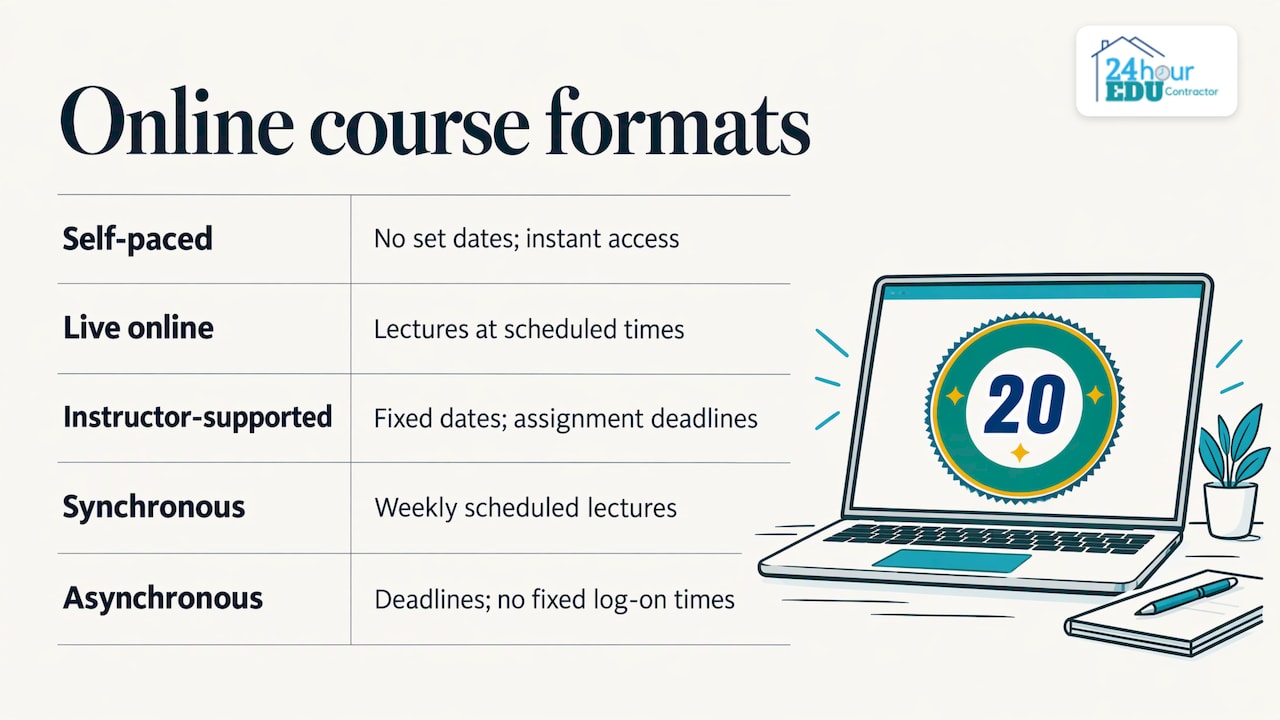
Universities describe the main formats clearly. UBC Extended Learning lists self-paced courses with no set dates and instant access, live online lectures at scheduled times, and instructor-supported courses with fixed start and end dates and assignment deadlines. BCIT explains that synchronous courses require weekly scheduled lectures, while asynchronous courses have deadlines but no fixed log-on times. Thompson Rivers University’s Open Learning calendar notes that its self-paced courses allow up to 30 weeks from registration, while paced courses run on a set term.
For a builder, the practical question is simple: does the course ask you to be at a screen at a set hour? During the building season, that is hard to promise. Our courses are online self-paced video courses with lifetime access, so you start when the day allows and stop when the site calls. They have no final exams.
How to choose a course that counts
BC Housing’s CPD Guide gives a clear set of tests. Use them as your checklist.
- Relevance. The training must be directly relevant to the construction industry and address at least one competency area, such as relevant enactments or construction technology.
- Approval status. BC Housing recommends looking at its Education Registry for pre-approved courses. Approved providers display the BC Housing Core Competency logo. Our courses are approved by BC Housing for CPD credits.
- Verifiable completion. You need evidence you can keep: a certificate, receipt and course outline.
- No double counting. You cannot claim points for a course you have already claimed.
- Full completion. Complete online training in full. BC Housing warns that skipping through material can lead to reduced or no points if you are audited.
The same competency thinking applies across residential work. Even a task as specific as preparing permit-ready plans, the kind of work behind building permit drawing services, depends on code knowledge and clear project documentation. A course that strengthens those skills is relevant in the way BC Housing means.
Time and points
BC Housing counts only active class time. So the arithmetic for a builder is straightforward: 20 points is the target, and the points per hour depend on whether the learning is formal or informal. Read the course description to see how many hours and points it is worth before you buy. Our guide to completing 20 BC builder CPD points online lays out a way to plan the total.
A practical routine for the licence term
This routine keeps you ahead of the deadline and the audit.
- Note your expiry date and your nominee. Put both in your calendar the day your licence renews.
- Count what you already have. Add any carry-over points from the last term, if the nominee has not changed.
- Pick courses by gap, not by convenience. Choose subjects that match how your business actually runs: contracts if you handle disputes, estimating if you bid often, building science if you build envelopes.
- Take the courses in short sessions. Self-paced video lets you finish a module in an evening. Watch it fully, because BC Housing counts active learning time only.
- File your proof the same day. Save the certificate and receipt, and note the activity description, date, subject area, provider, learning method and points claimed. The regulation lists these record details and requires you to keep them for at least three years.
- Report points before expiry. Enter them in the Licensed Residential Builders portal. We explain the process in how to report your CPD to BC Housing.
If you want a fuller picture of how the program is structured, our overview of BC contractor CPD is a good companion, and the construction continuing education page shows the broader education options for BC builders.
Our courses for BC residential builders
We built our catalogue for one group: licensed residential builders, general contractors and construction company owners in British Columbia. The courses are practical and written around real residential work. They are approved by BC Housing for CPD credits, they are delivered as online self-paced video courses, and there are no final exams.
Each course is $29 CAD, one-off, with lifetime access and clear course information upfront. Live customer support is available seven days a week if you have a question about a course or your access.
Browse the full list of online courses for contractors, or go straight to the 20-point CPD bundle for BC residential builders to work toward your full term requirement.
Our view: CPD should fit the way builders work
Most builders we talk about CPD with are not worried about learning. They are worried about timing. A licence term is one year, the building season is short, and a course that insists on set hours or a final exam competes with a job site.
That is why we made our courses online self-paced video courses with no final exams. You decide when you sit down to watch, and your access never expires, so you can come back to a lesson on contracts or building science when a real project raises the question.
We keep the price at $29 CAD per course so that choosing the subjects you need does not become a budget argument. And because our courses are approved by BC Housing for CPD credits, you can spend your time on the content instead of wondering about the paperwork.
Our advice is to plan your 20 points at the start of the term, take them in small pieces, and file your certificate the same day. If you get stuck, our support team is there seven days a week.
Chuck Pulaski
FAQ
Can I complete all 20 CPD points online?
BC Housing accepts online training, provided the content is directly relevant to residential construction and you can prove completion. The requirement is 20 points per one-year licence term. Our courses are online self-paced video courses, so you can build the total from a series of them.
How long do I need to keep my CPD records?
The Homeowner Protection Act Regulation requires you to keep proof of each CPD activity for at least three years. Records should include the description and date, subject area, delivering organization, learning method, points claimed, and copies of certificates, receipts and syllabi.
What happens if I do not report my CPD in time?
BC Housing requires CPD points to be entered before your licence expiry date. Failing the CPD condition can lead to a denied renewal, suspension or a monetary penalty, and building or selling new homes after expiry is an offence. Report early and check the portal confirms your entry.
Do extra points carry over to the next year?
Yes, up to 20 extra points can carry over to the following term, but only if the CPD nominee stays the same. If a new nominee is selected at renewal, the carry-over points are lost.
Is there support if I get stuck in a course?
Yes. Our live customer support is available seven days a week, and each course has clear information upfront so you know what you are enrolling in.
Sources
- BC Housing: Continuing Professional Development (CPD)
- BC Housing: Qualifications Training for Licensed Residential Builders
- BC Housing: Renewing Your Residential Builder Licence
- BC Housing: CPD Guide, Chapter 3
- BC Housing: Core Competency Requirements
- BC Laws: Homeowner Protection Act Regulation
- UBC Extended Learning: How online courses work
- BCIT: Online learning formats
- Thompson Rivers University: 2026-2027 Open Learning Academic Calendar