The BC Energy Step Code is the performance-based energy pathway in the BC Building Code. It is mandatory for new Part 9 residential buildings in most of the province. Instead of prescribing insulation values part by part, it sets an energy outcome that the whole building must reach, and it asks you to prove that outcome with an energy model and an airtightness test. If you build houses, townhouses or small apartment buildings, you work to it on every permit. We also look at how Step Code knowledge connects to the 20 training points you need to renew your licence, and how our self-paced video courses, approved by BC Housing for CPD credits, fit into that.
TL;DR
- The Step Code is Subsection 9.36.6 of the BC Building Code and covers new Part 9 residential buildings, with exceptions such as the City of Vancouver and federal lands.
- Since May 1, 2023, Part 9 residential buildings must meet Step 3 or higher. Your local government can require more through a bylaw.
- Compliance rests on whole-building energy modelling and blower door airtightness testing, with checklists at pre-construction, mid-construction and as-built stages.
- Licensed residential builders need at least 20 training points to renew, and training on the building code and its application to residential construction can count toward them.
- Our $29 CAD courses are online, self-paced and have no final exam.
Table of Contents
- What the Step Code is and where it applies
- How the steps differ
- How you show compliance
- Keeping up with changes
- How Step Code knowledge counts toward your licence
- Our approach to Step Code learning
- Take your CPD courses online
- FAQ
- Sources
What the Step Code is and where it applies
The province introduced the Step Code in 2017. Its stated reasons were that local governments wanted more efficient new buildings, builders wanted consistent requirements across neighbouring municipalities, and the province wanted to cut energy use and greenhouse-gas emissions.
The code speaks in terms of “Part 9” and “Part 3” buildings. Part 9 is the section of the BC Building Code for houses and small buildings. In practice, as the City of North Vancouver explains, a Part 9 residential building is three storeys or fewer with a footprint of 600 square metres or less. Anything taller or larger falls under Part 3. Pitt Meadows describes the same threshold for its own permits.
According to the provincial handbook for building officials (March 2025), the Step Code applies to:
- single-family homes
- homes with a secondary suite
- townhouses
- small apartment buildings where common space is no more than 20% of floor area
Log homes are included but may use other compliance pathways. Non-residential, mixed-use and seasonal buildings are not required to comply. The Step Code also does not apply in the City of Vancouver, which has its own building bylaw, or on federal lands.
One more point catches builders working across several municipalities. The province sets the minimum, but local governments can require higher steps through bylaw, and what applies to you depends on the permit date and the location. Check the requirements of the municipality before you price a job, not after the design is finished.
How the steps differ
A step is a defined level of energy performance. The province describes five steps:
| Step | What it means |
|---|---|
| Step 1 | Energy performance is modelled and tested, with performance at the basic building-code level |
| Step 2 | Usually about 10% better than Step 1 |
| Step 3 | Around 20% better |
| Step 4 | Around 40% better |
| Step 5 | “Net-zero energy ready” |
The provincial goal is for all new buildings to reach Step 5 by 2032.
What matters on site is that the steps are not a checklist of materials. The code sets an outcome and leaves it to the design and building team to decide how to reach it. That is why a digital whole-building energy model is needed before the design is finalized, which replaces the older approach of meeting requirements element by element.
Which step applies to your permit
The province’s code page says the first step-up happened in May 2023, when most new buildings had to be 20% more energy efficient than the 2018 minimums. Steps 1 and 2 for smaller buildings are now listed as “Reserved” in the BC Building Code and no longer meet minimum requirements.
For your day-to-day work, the handbook gives two dates:
- From May 1, 2023, Part 9 residential buildings must comply with Step 3 or higher of the Energy Step Code.
- From March 10, 2025, they must also comply with Emission Level 1 (EL-1) or higher of the Zero Carbon Step Code.
The Zero Carbon Step Code measures greenhouse-gas emissions from building systems, rather than energy use. It has a performance pathway that uses the energy model results and a prescriptive pathway that does not use modelling. The provincial goals are Step 5 by 2032 and EL-4 by 2030.
How you show compliance
The Step Code is demonstrated with documents and tests, not with a site inspection alone. The handbook sets out the main elements.
Energy modelling
Modelling is required at every step. It is normally done by an Energy Advisor using the EnerGuide Rating System, or by another qualified modeller. Alternative pathways exist: BC Building Code Subsection 9.36.5, NECB Part 8 with Vancouver guidelines, and the Passive House Planning Package for Step 5.
The code looks at annual energy use regardless of the energy source, and it counts operational energy only. On-site energy production is not counted. That means a solar array will not rescue a poorly performing envelope.
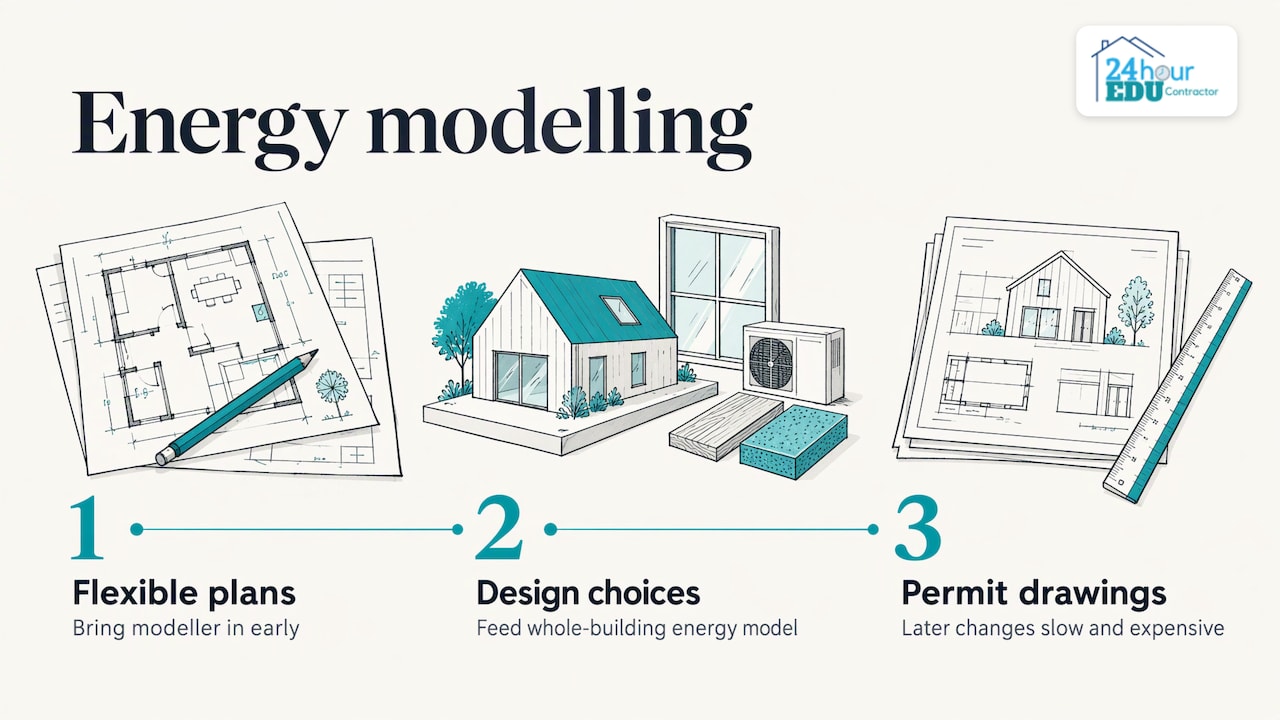
The practical lesson is to get the modeller involved when the plans are still flexible. Window specification, wall assembly, mechanical system and building shape all feed the model, and changing them after the permit drawings are done is slow and expensive.
Airtightness testing
Whole-building airtightness is measured with a calibrated blower door fan, at the pre-construction and as-built stages, and the results feed back into the model. As the City of Surrey notes, at Step 1 airtightness must be good enough for the building to match the reference building, while at Step 2 and above buildings must meet specific airtightness levels.

Since May 2023, the code has also included more airtightness testing options suited to smaller homes in cold climates. Technical Bulletins B23-01, B23-02 and B23-03 describe the changes and compliance paths.
Airtightness is largely decided by workmanship: how the air barrier is detailed at penetrations, rim joists and window openings. Good wall-assembly practice, including a properly installed house wrap and flashing under siding, supports the continuous barrier that a blower door test then measures. Run your own interim test before drywall goes up, when you can still reach the leaks.
Checklists and documents
The province’s Part 9 compliance checklist manual provides pre-construction, mid-construction and as-built (occupancy permit) checklists. Builders use them to demonstrate compliance and local governments use them to verify it. Keep them with the job file from the start of the project.
For official builder-facing guidance, the province’s builder and industry resources page lists the BC Energy Step Code Builder Guide for all Part 9 buildings. BC Housing’s Builder’s Visual Guide (May 2026) explains that at the top of the scale, Step 5 relies on a well-designed, well-built envelope with deliberate attention to airtightness, thermal bridging and mechanical system design.
Where projects lose a step
Most problems come from the same few places:
- The model was run once, early, and never updated after design changes.
- Windows or mechanical equipment on site differ from what was modelled.
- The air barrier is detailed on paper but not sealed at penetrations.
- The builder assumed the neighbouring municipality’s requirement applied in this one.
- The checklists were filled in at the end instead of at each stage.
Each of these is a process fault that can be fixed with a routine, and your trades need to know that routine as much as you do.
Keeping up with changes
The Step Code is updated on a regular schedule, and the province publishes technical bulletins when interpretations or pathways change. The bulletins page lists a 2026 bulletin, B26-01 “Step Codes and Z240”. Before you start a project, check the bulletins page and your municipality’s building department for what applies to your permit date.
For a deeper look at design choices, see our guides on building energy efficient homes in BC and what residential builders need to know about the BC step code.
How Step Code knowledge counts toward your licence
Step Code work sits inside the competency area of the building code, and that connects it to your licence renewal. According to BC Housing’s CPD Guide, licensed residential builders need at least 20 training points to renew. Formal training earns two points per hour and informal training one. Training must address a competency area, such as relevant enactments, including the BC Building Code and BC Fire Code and their application to residential construction.
The same guide says that training must be relevant to the construction industry and verifiable, that BC Housing can audit your training records, and that skipping through online training may result in reduced or no points. Keep your completion records so that you can report them cleanly. We explain the process in how to report your CPD to BC Housing, and in how to complete 20 BC builder CPD points online. If you are not sure where your licence stands, our overview of BC residential builder licensing requirements is the place to start. For wider context on this topic, read about green building training for BC contractors.
Our approach to Step Code learning
Builders tell us the Step Code is not hard to understand. It is hard to find time for. You are on site all day, and training has to fit around that.
That is why our courses are online, self-paced video courses, approved by BC Housing for CPD credits. You start and stop when your schedule allows, there is no final exam, and you keep lifetime access to the course. Live customer support is available seven days a week if you need help.
We keep the content practical and relevant to how BC residential builders actually work. A builder who understands building science, contracts, estimating and risk is better placed to run a Step Code job, because the energy model, the airtightness test and the checklists all land on the same schedule and budget.
Chuck Pulaski
Take your CPD courses online
Our catalogue has ten courses, each $29 CAD as a one-off purchase. They include Residential Building Science for Contractors, Construction Contracts and Dispute Resolution Online, Estimating, Bidding, & Procurement for Residential Contractors, and Construction Safety and Risk Management. Each is an online, self-paced video course approved by BC Housing for CPD credits, with no final exam.

You can see the full list on our online courses for contractors page, or go straight to the 20-point CPD bundle if you want to cover your renewal in one go.
FAQ
What is the BC Step Code?
It is the performance-based energy pathway in the BC Building Code, in Subsection 9.36.6, for new buildings. It sets stepped levels of energy efficiency, and you show compliance with an energy model and airtightness testing. It was established in 2017.
What is Step 3 of the Step Code?
Step 3 is a level of performance around 20% better than the base level. Since May 1, 2023, Part 9 residential buildings must comply with Step 3 or above, and a local government may require a higher step through its bylaw.
Does the Step Code apply to renovations or to the City of Vancouver?
The code covers new Part 9 residential buildings. It does not apply in the City of Vancouver or on federal lands. Seasonal, mixed-use and non-residential buildings are not required to comply either. For a specific project, confirm the requirements with the building department that issues your permit.
Do I need an energy model for every Step Code project?
Yes. Modelling is required at all steps, normally by an Energy Advisor or another qualified modeller, with a few alternative pathways. The model should be completed before the design is finalized.
How many training points do I need to renew my licence?
You need at least 20 training points. Formal training earns two points per hour and informal training one, and the training must address a competency area such as the building code.
Sources
- BC Energy and Zero Carbon Step Codes: A Builder’s Visual Guide, BC Housing
- Continuing Professional Development (CPD) Guide, BC Housing
- BC Energy Step Code for New Buildings, City of North Vancouver
- BC Energy Step Code, City of Pitt Meadows
- BC Energy Step Code and Zero Carbon Step Code, City of Surrey
- House wrap under siding and flashing