Construction project closeout is the final phase of a job. You finish and verify the work, hand over the documents the owner needs, settle the money and release your obligations. In British Columbia, a clean closeout depends on planning it from the start and knowing the holdback timelines under the Builders Lien Act. Builders who treat it as a project-management skill rather than end-of-job paperwork get paid sooner and avoid callbacks. Our BC Housing-approved CPD courses, which are online self-paced video courses, cover the business and risk skills behind this.
TL;DR
- Closeout starts at the contract stage, not at the last day on site. Write closeout submittals into the contract and the schedule.
- Ready-for-Takeover (a contract milestone) and the Certificate of Completion (a statutory milestone) are separate in BC and need not happen together.
- The Builders Lien Act sets a 10% holdback in covered cases and a 55-day holdback period after the applicable trigger.
- Collect trade documents by 75% completion of each trade’s work to avoid handover delays.
- Work through the checklist below: inspections, deficiencies, documents, final invoice, holdback release.
Table of Contents
- What closeout means and when it begins
- Who is responsible for what
- The closeout process, step by step
- Closeout documents to have ready
- Final payment, holdback and lien timing in BC
- Why closeout goes wrong
- Perspective
- Build closeout skills into your CPD
- FAQ
- Sources
What closeout means and when it begins
Closeout is the coordinated completion, verification and handover of the contractual work, the operating information and the financial and statutory requirements. The British Columbia Construction Association’s 2023 Closeout Guide says closeout requirements arise in the contract documents and continue through construction, so it is not only an end-of-job task.
The same guide distinguishes two milestones. Ready-for-Takeover is a contractual milestone. The Certificate of Completion is a statutory one under BC law. They can fall on different dates, so track each separately.
You will also see the term written as “close out” (verb) and “closeout” (noun or adjective). Use “closeout” for the phase and the documents, and “close out” for the action of finishing a job.
Who is responsible for what
BC Housing’s Guide to Building Handover sets out the roles, and they apply in principle to most projects:
| Participant | Closeout role |
|---|---|
| General contractor | Logs, collects and submits the closeout documents named in the contract |
| Trades | Submit their closeout documents and correct deficiencies |
| Prime consultant | Clarifies requirements, reviews submissions, accounts for incomplete documents in deficiency holdbacks |
| Project manager or development consultant | Coordinates the contractor, consultant and owner or operator |
| Owner or operator | Reviews handover information and prepares to operate the building |
As the general contractor, you carry the most weight. Your subcontractors’ late paperwork becomes your delayed payment.
The closeout process, step by step
1. Plan closeout in the contract and schedule
Put closeout submittals in the contract documents and the construction schedule. BC Housing recommends keeping a submittal log, reporting its status at site meetings and coordinating operations-and-maintenance (O&M) review and as-built drawings early. The common failure is treating these as end-of-job items, when no one has time left to chase them. If you want a stronger grounding in scheduling, our Construction Scheduling and Timeline Management course is $29 CAD one-off.
2. Collect trade documents by 75% completion
BC Housing recommends obtaining each trade’s closeout documents by 75% completion of that trade’s work, with the requirement written into the contract. Once a trade has left site, getting their warranties and manuals is far harder.
3. Run inspections and the deficiency list
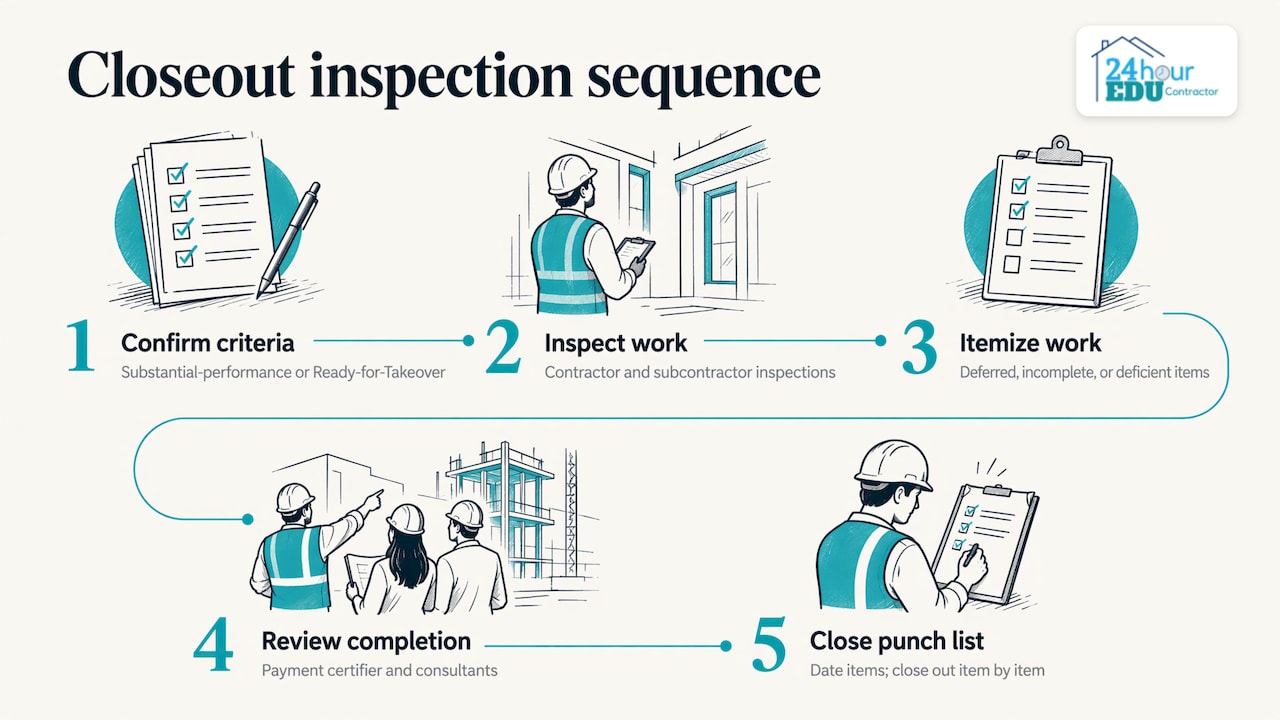
A completion checklist should include the contract’s substantial-performance or Ready-for-Takeover criteria, contractor and subcontractor inspections, itemized lists of deferred, incomplete or deficient work, and a final review by the payment certifier and consultants. The owner may take part. This is described in the OAA-OGCA 2026 take-over procedures, an Ontario document that is a useful model for the sequence. The punch list (the list of minor items still to fix) should be itemized, dated and closed out item by item.
4. Meet the Ready-for-Takeover prerequisites
Under the CCDC 2-2020 contract, the Royal Architectural Institute of Canada lists prerequisites such as consultant verification of substantial performance, evidence of occupancy-permit compliance, required final cleaning, immediate-use O&M documents, current as-built drawings, required startup and testing, and scheduled demonstrations or training. Check which contract form you are on and what it requires.
5. Submit the closeout documents
See the document list in the next section.
6. Request a completion determination
Under BC’s Builders Lien Act, a contractor or subcontractor may request a completion determination. The payment certifier must decide within 10 days and, if it finds completion, issue a certificate, with a copy and site notice distributed within 7 days.
7. Invoice, hold and release
Issue a proper final invoice after deficiencies are corrected, then manage holdback release as described below.
Closeout documents to have ready
BC Housing’s handover guide lists these submissions: specification-required submittals, O&M manuals, as-built drawings, evidence of WorkSafeBC good standing, a statutory declaration, an updated survey, keys, appliance warranties, photographs and a fire-safety plan.
The RAIC adds warranties and bonds with warranty dates, maintenance materials and spare parts, and certifications for operating systems such as fire alarm, sprinkler, HVAC, security and boiler. The 2026 Chambers Canada construction law guide describes a contractor closeout log that lists testing and commissioning certificates, maintenance manuals and as-built drawings. Guidance on common pavement and site-marking handover items shows how life-safety records feed into the final submissions on commercial work.
A practical checklist for a residential job:
- Final inspection sign-offs and occupancy documentation
- Deficiency list, with each item closed and dated
- As-built drawings and O&M manuals
- Warranties, with start dates, and keys
- WorkSafeBC good-standing evidence and statutory declaration
- Final cleaning confirmed
- Final invoice and holdback application
For the home warranty side, see our guide to BC new home warranty requirements.
Final payment, holdback and lien timing in BC
The Builders Lien Act requires a 10% holdback in the circumstances covered by section 4. The holdback period is 55 days after a certificate of completion or, where none applies, after specified completion, abandonment or termination events. The British Columbia Law Institute explains that the lien-filing period is generally 45 days while the holdback period is 55 days, and that the trigger depends on the project. Holding funds past the filing window preserves security for lower-tier claimants until lien exposure is known.
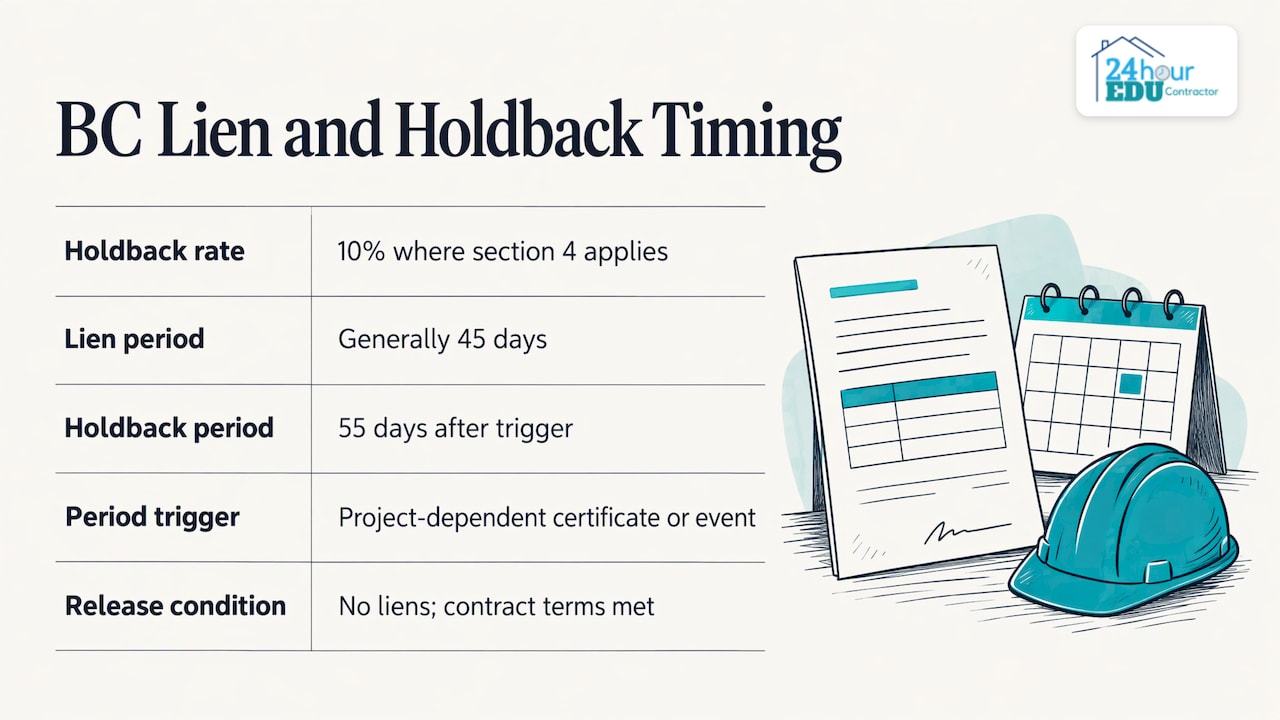
Worked example: a certificate of completion is issued on a given day. The 55-day holdback period runs from that day. If no liens are filed in the 45-day filing period, the holdback can be released once the 55 days have passed, provided your contract’s other conditions are met. Because the trigger depends on whether a certificate is issued, requesting the completion determination early gives you a firm start date. The Chambers guide also notes that BC’s prompt-payment and adjudication legislation received Royal Assent in November 2025, so check the current in-force status before relying on older payment timelines. For a lien question on a specific job, speak to a construction lawyer.
Why closeout goes wrong
- Closeout submittals were never written into the contract, so no one owns them.
- Trade paperwork is chased after the trade has demobilized.
- The deficiency list grows because inspections happen late.
- The completion request is delayed, so the holdback clock does not start.
- The final invoice is sent before deficiencies are closed.
Each comes back to planning, scheduling and contract discipline.
Perspective
Most closeout trouble we hear about is a business-systems problem, not a carpentry problem. A builder who writes submittals into the contract, tracks them in a log and requests completion promptly has a different closeout from one who leaves it all to the last week.
That is why our courses cover scheduling, contracts and dispute resolution, financial management and risk management as practical subjects. They are approved by BC Housing for CPD credits, delivered as online self-paced video courses with no final exams, and you get lifetime access. Our live support is available seven days a week.
Chuck Pulaski
Build closeout skills into your CPD
If you are choosing CPD for your licence renewal, closeout is touched by several of our courses: Construction Contracts and Dispute Resolution Online, Financial Management and Accounting for General Contractors, Construction Scheduling and Timeline Management, and Risk Management and Contingency Planning. Each is $29 CAD one-off, approved by BC Housing for CPD credits. See the full course list or our licence renewal checklist.
FAQ
What does project closeout mean in construction?
It is the final phase, when the work is verified, documents are handed over, payments are settled and statutory requirements are met. In BC, the requirements are set in the contract documents and run through construction.
Who is responsible for closeout?
The general contractor logs, collects and submits the closeout documents. The prime consultant clarifies and reviews them, trades submit theirs and correct deficiencies, and the owner or operator reviews the handover information.
How long is the holdback period in BC?
The Builders Lien Act provides a 55-day holdback period after the applicable trigger, such as a certificate of completion. The lien-filing period is generally 45 days. Confirm the trigger for your project with a construction lawyer.
When should I collect subcontractor closeout documents?
BC Housing recommends by 75% completion of each trade’s work, with the requirement written into the contract. This reduces handover delays.
Sources
- BCCA Closeout Guide (2023)
- BC Housing Guide to Building Handover
- OAA-OGCA Take-Over Procedures 2026
- RAIC Chapter 6.7
- Builders Lien Act, SBC 1997, c 45
- BCLI, Running of Time for Filing of Liens and Release of Holdback
- Chambers Construction Law 2026, Canada
- Final handover submissions and site markings